Tuesday, February 28, 2006

How Blonde Am I?

You Are a Golden Blonde

Men see you as flirty and fun, yet deep and thoughtful
You've got all the pizzazz of a blonde...
With the intensity of a brunette


Will wonders never cease! I used to be a Golden Blonde. Now I'm a Golden Blonde "used-to-be."

(H/T: Julie D. at Happy Catholic)

Lenten Resolutions

One thing about being Catholic—we have many opportunities to make Resolutions.  Or to re-make Resolutions, the ones that get broken on January 2.

Lent is just such an opportunity.

When I was a kid, Lent was more about “giving up” than about becoming a better person.  The idea was that by making little sacrifices we would participate in the larger sacrifice that Jesus made on our behalf on Calvary.  One year we actually made a spinner, using paper brads and a paper plate.  The idea was we would write down different things we could do, like “No Candy” or the dreaded “No TV”.  Each morning, we would spin the arrow and give up whatever was indicated for that day.  (It was amazing how infrequently “No TV” came up.  The idea that we could do something instead of give up something came much later in our theological development and was probably a product of Vatican II thinking.

No matter what I do during Lent, when Easter comes I never feel that I’m as ready as I should, or could, be.  But I try anyway, working on areas that definitely need some type of improvement, denying myself some treat because I want to demonstrate my control over my body.  Hubs, who is not Catholic, doesn’t understand this.  What’s the point in giving up alcohol if you’re not an alcoholic?  Why deny yourself chocolate or chewing gum or popcorn—they are such innocuous treats?  Why give up meat on Fridays and snacks on Ash Wednesday or Good Friday?  Why go to church when you don’t have to?  (That would be Ash Wednesday and the Tridium.)  Why is fish not meat yet chicken is?  If the kids are out of school on Good Friday, why can’t he take them to the movies?  

My answers don’t make sense to him.  I’ve resorted to the weak argument of “Because that’s what we Catholics do.  It’s Tradition.”  

After 27 years of marriage (March 10), he’s come to accept my Lenten quirks.  

This year I’ve got two goals.  The first is to give up popcorn.  This doesn’t sound tough, but I eat at least one bag a day.  It’s practically mandatory if we go to the movies.  A small thing, but something I will miss.

The other goal is tougher:  to keep my kitchen sink clean.  (Those of you who know the Fly Lady recognize this one.)  I hate housework.  I’ve tried to find joy in domesticity, in taking care of my family the way Mary took care of Jesus and Joseph, but my heart and mind just don’t buy it.  Keeping my sink clean and shiny—okay, just keeping it clean—is really a small thing, but it is something I tend to put off as long as possible.  

Unlike some bloggers I know, I need to become more Martha and less Mary.

My parish bulletin publishes the readings for the week.  I have been trying to keep up with those so that the Sunday readings can be heard and understood in the larger context of the Church.  I will continue that practice during Lent, trying to be more consistent.  

I’ll be issuing “Progress Reports” during the next six weeks, as well as checking out other websites and blogs for ideas and inspiration.

As always, prayers and good wishes are welcome!

Book Review: Sense and Sensibility

2006 must be my year for Jane Austen…

Sense and Sensibility is the tale of two sisters and their quest for love.  Since this takes place in the early-1800’s, the quest also involves marriage.

Elinor Dashwood, the oldest sister, is full of sense.  She is the one that her mother and her sisters look to in a crisis.  And the crisis starts early, with the death of Mr. Dashwood, husband and father.  The Mrs. Dashwood and her daughters find themselves forced to move from their home of Norwood, which has been passed down to Mr. Dashwood’s son from his first marriage.  John moves in with his wife and their child.  Although John promised his father that he would take care of his stepmother and half-sisters, Mrs. John Dashwood soon persuades him that merely letting Mrs. Dashwood and her daughters stay at Norwood until they can find more suitable lodgings is enough.

Fortuitously, a distant relation, Sir John Middleton, offers to rent Mrs. Dashwood a small cottage near his estate in Barton.  At Elinor’s urging, Mrs. Dashwood accepts, although it is somewhat smaller than she had in mind.  The family settles in and becomes acquainted with Sir John, his Lady, and their friends and family.

Marianne Dashwood is the second sister.  She is full of sensibility, which in this case means she follows her heart rather than her head.  She falls while walking the hills near Barton and is returned home by a handsome young man, Mr. Willoughby.  She fancies herself in love with him— and him with her—and life is good.  At least, for the moment.

Elinor, meanwhile, has fallen in love with her sister-in-law’s brother, Edward Ferrars.  But they are quite circumspect and quiet about their love, which causes Marianne to wonder if they are attracted to each other.  

In the background is Colonel Brandon, a friend of Sir John Middleton, who has fallen in love with Marianne.  But his personality is more like Elinor’s:  quiet and proper.  Marianne thinks him too old and too dull.  Mrs. Jennings is Lady Middleton’s mother.  She becomes the social catalyst for the Elinor and Marianne, introducing them to London society.  The two Miss Steele’s are distant relatives of Mrs. Jennings who come to stay with the Middleton’s during the summer.  Elinor and Marianne also run into them while in London.  Lucy Steele befriends Elinor, who does not completely trust Lucy’s profession of friendship.

Whew!  

Sense and Sensibility was the first novel published by Miss Austen.  Some of the themes—such as the unreliability of first impressions—are explored more fully in Pride and Prejudice.  Mrs. Dashwood, although more inclined to think with her heart than her head, is not as silly as Mrs. Bennet.  Manners are quite important in this novel as well, since they are often a reflection of the quality of the interior of a person as well as just the exterior.  But not always.   Money—or lack of it—can be the motivation for a person’s behavior towards another.  

One of the reasons why I like Jane Austen is that her observations of human behavior are still relevant.  Yes, the social rules have changed:  unmarried men and women can exchange letters, women are not so financially dependent upon their male relatives, and marriage is more of a personal choice.  But there are still people who have sense, those who have sensibility, those who keep their intellects active, those who chase after social status, those who spoil their children, those who behave honorably, and those who are “diamonds in the rough.”  

We “modern” humans are not as different from our forebears as we pretend to be.  Our concerns, at least at the human-to-human level, remain much the same.  Jane Austen captures that level with wit, style, and grace that more modern authors would do well to emulate.

I didn’t like Sense and Sensibility quite as much as Pride and Prejudice.  Still, S&S was an enjoyable read.

On the March Hare scale:  4 out of 5 bookmarks.  

I’m not sure which Jane Austen novel I’ll read next.  Probably Persuasion or Mansfield Park.

Friday, February 24, 2006

My 24 Hours of Fame

Michelle the Magnificent Malkin actually linked to my blog publicly a couple of days ago, referencing this post.

I actually got several trackbacks from it and I moved up a couple of levels in the Ecosystem. I was very excited and very happy!

However, life is returning to normal and I'm sure I'll devolve again back to my appropriate level.

To help me along, comes this Litany of Blog Humility(hey, I am Roman Catholic, after all!), courtesy of the Curt Jester, by way of The Happy Catholic:

The Litany of Blog Humility

From the desire of my blog being read
Deliver me dear Jesus

From the desire of my blog being praised
Deliver me dear Jesus

From the fear of my blog being despised
Deliver me dear Jesus

From the fear of my blog being forgotten
Jesus, grant me the grace to desire it

From the fear of no page views
Deliver me dear Jesus

That other blogs may be loved more than mine
Jesus, grant me the grace to desire it

That Nihil Obstat may find all my grammatical and spelling errors
Jesus, grant me the grace to desire it

That Google may never list my blog
Jesus, grant me the grace to desire it

That comments always be negative and abusive
Jesus, grant me the grace to desire it

That my commenting system always say "commenting temporarily unavailable"
Jesus, grant me the grace to desire it

That Mark Shea may notice every blog but mine
Jesus, grant me the grace to desire it

That others may be pithier than I, provided that I may become as pithy as I should
Jesus, grant me the grace to desire it


bloggerpatron

St. Jerome, pray for us.

Thursday, February 23, 2006

Which Star Trek Character Are You?

Picard
Jean-Luc Picard. You command your ship with an

iron fist and the children love you. Bah!!!

Humbug!! KIDS!!! >_<


Which Star Trek Character Are You?
brought to you by Quizilla


Okay, I'm shocked. I figured I'd be Bones or Beverly. Jean Luc? Wow! That's way cool!

(H/T: Julie D. at Happy Catholic)

Wednesday, February 22, 2006

Because A Picture Is Worth 1000 Words

This is a picture of a container terminal from the BART train. The orange and the white boxes are
shipping containers.

On the middle left of the picture, a truck tractor is pulling a container out of the yard on a chassis.

The tall white structure behind it--the one that looks like something out of The Empire Strikes Back is the crane used to lift containers on or off the ships.


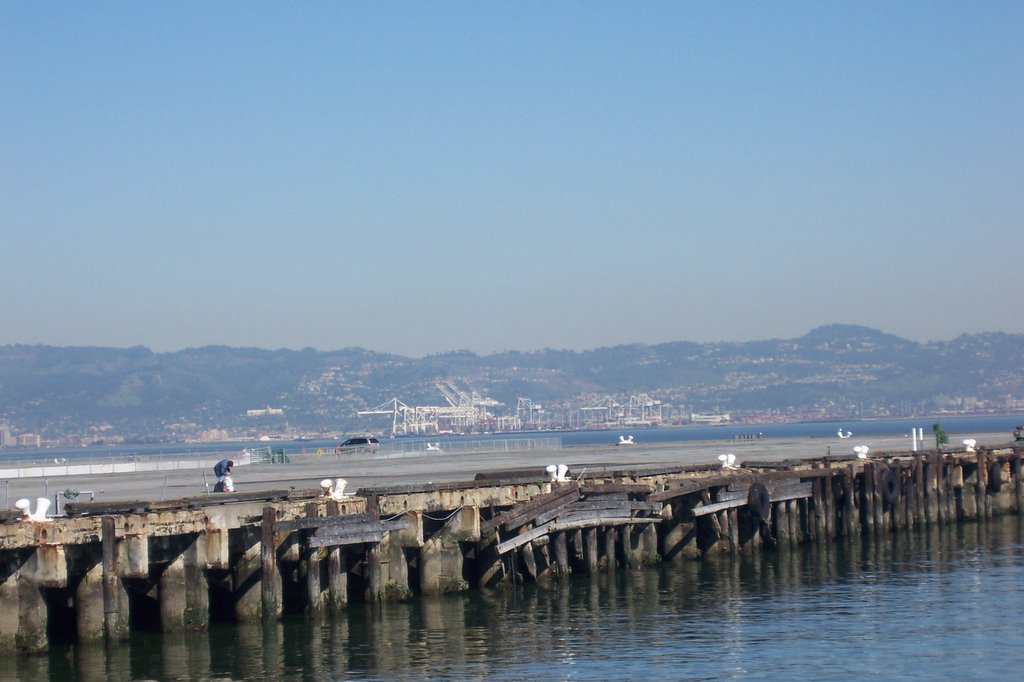
This is a picture of the same terminal, taken from across the Bay. It's a quiet day--no ships are working.


DISCLAIMER:
This terminal is not one of the terminals that might be/could be/will be operated by DPW. However, ports are often very close to population centers and other transportation networks: interstates and rail lines.


A Tinfoil Hat Moment

Is anyone else enjoying the irony that several folks on the left have asked why Haliburton can't take over the port operations from P&O instead of DP World?

[/tinfoil hat on]

The Evil Dick Cheney deliberately shot his friend to distract The Media from the fact that agents from the Government of Dubai were plotting to take over six U.S. ports.

Cheney knew there would be an uproar in Congress and that Congressional Leaders would never let this happen. Haliburton would then be able to ride into town on a white horse and play the part of the Reluctant Hero Who Saves Us From The Bad Guys. And no one would suspect a thing.

Of course, Karl Rove knew about this and so did Bushitler.

Bwaaahahaha...


[/tinfoil hat off]

Congress Should Talk to the Experts

My biggest fear in the current brouhaha over DP World buying P&O Terminals isn't the government of the UAE.

My biggest fear is the U.S. Congress.

My fear is that Congress feels it has to Do Something. And that often equals Bad Legislation.

At best, we could be subject to another Commission, who will spend much taxpayer dollars, study the situation for a year, release their findings and recommendations--which will promptly be ignored, forgotten, or set aside if convenient--and, like Pontius Pilate, wash their hands of further responsibility.

"We did our duty. Now, let's see how much money we can gut from the U.S. Coast Guard."

In 2001, I was working for a steamship line. After 9/11, one of our favorite water cooler topics was "How Would We Have Done It Better?" We had the advantage in knowing the vulnerabilities of the system, of where the weak links were.

For its part, U.S. Customs and the Coast Guard have been trying to close those gaps. There is an entire program called Customs-Trade Partnership Against Terrorism (known as C-TPAT). There is the 24-Hour Rule, where steamship lines send a manifest to Customs 24 hours before the vessel arrives at the foreign port of loading. Once that manifest is transmitted, it is almost impossible to edit it.

INS, for their part, requires a complete list of crew members and passport information. Getting off the ship (not that ships are in port long anyway) is discouraged.

But spend $6 billion just to blow up a port terminal? I can think of a couple of ways to do damage for a lot less. Remember, the 9/11 hijackers didn't own the planes or the airport terminals. They had box cutters, available at any office supply or hardware store, and themselves.

If I were truly interested in port security, I'd take the yard superintendents, the walking bosses, the clerks, the truck drivers, transtainer and container crane operators out to the local dive and spring for beer. They can tell you where the security holes are and probably have some good ideas how to fix them. Chances are they've been talking about this since 9/11 as well.

And I'd increase the operating budget of the Coast Guard and Customs so they can do their job. Especially in the area of data mining the manifests to flag suspicious cargo. Customs needs a Chloe O'Brien and the computer power of CTU in 24. They don't have it.

But my suggestion doesn't provide much of a photo op.

On Shoes and Ships and Sealing Wax...

What do the following have in common: Pan Am, Trans World Airways, Eastern Airlines, U.S. Lines, Pacific Far East Line, American President Lines, SeaLand?

They were all U.S. flag carriers at one time. Pan Am, Trans World Airways, and Eastern Airlines were airlines. U.S. Lines, Pacific Far East Line, American President Lines, and SeaLand were U.S. flag steamship lines.

American President Lines (APL) and SeaLand still exist as part of foreign flag carriers. APL is owned by Neptune Orient Line (NOL) in Singapore; SeaLand is part of Maersk-SeaLand, owned by the Danish company, A.P. Moller.

The same game can be played with railways: Southern Pacific, ATSF (Atchison, Topeka, & Santa Fe), Burlington Northern, Chesapeake & Ohio.

I can't keep track of the trucking companies that have come and gone.

The transportation industry has some unique constraints. Capital costs are high, as are labor costs. Profit margins are extremely small. A price increase of a penny a gallon (or ton in the case of ships) in fuel has a big impact in overall costs. So transportation operators try to cut costs wherever they can.

They can charge their customers more. That works if they are a monopoly or if few other operators care to serve that particular market. But, in the free market, once someone figures out there is money to be made, then others swarm. Prices decline (although costs don't) and consumers benefit.

They can try to cut back on their equipment maintenance or quality. But there is only so long an operator can defer maintenance on brakes or hulls or engine parts.

The operator can cut back on labor costs. And, in fact, this is often what they try to do. However, this has led to abuses of that labor pool: poor pay, long hours, unsafe working conditions. Labor fought back by forming unions.

One solution that has been tried is government support in the form of subsidies or protection from competition. The Union Pacific and the Southern Pacific were granted ownership of the lands along the track, which often proved more valuable than the railroad itself. Steamship companies had the Jones Act, which limits the transportation of goods between U.S. ports to U.S. flag ships, shipbuilding subsidies, and payroll subsidies. Airlines were granted monopolies on routes between U.S. cities and foreign countries. Truck lines also had route monopolies.

Maintaining oversight of all this involved an alphabet soup of Federal Agencies (FAA, ITC, FMC) and volumes of regulations, in fine print and flimsy paper.

During the Reagan Administration, much of this was swept away in the spirit of the Free Market. It was survival of the fittest.

The fittest were those with the lowest operating costs. Manufacturing and steel costs less outside the U.S.; so does labor. International Internet access means that the office doesn't need to be in the same geographic area as the terminus. In fact, it doesn't even need to be in the same country. The call center can be in the middle of the desert; data can be input from Manila.

The unions, watching as jobs moved out of their sphere of influence, fought any changes that might cause further erosion. Barcoding and scanning might be more efficient than having a clerk read the numbers and input them manually, but that means one less clerk might be needed.

Ships, airplanes, trucks, and locomotives became bigger and more powerful so that more cargo could be carried in one trip, using the same number of crew.

Meanwhile, customers demand better service and want to pay less for it.

Is there a solution?

More importantly, is there a free market solution?

My gut feeling is that this can't be done on the cheap and it won't be easy. Unions will have to give, stockholders will have to forfeit short-term profit, consumers will have to be willing to pay more, management will have to become more creative. These problems did not materialize overnight; they won't go away quickly.

On the other hand, in the early part of the 18th Century, a bunch of shipowners got together in the back room of a pub in London and discussed ways of mitigating the risk of sending sailing ships out to the far side of the globe and back again. The name of the pub was Lloyd's. Their solution has become part of history...

Saturday, February 18, 2006

Book Review: Fever Pitch

This is a book for the sports fan who has ever supported his or her team through thick and thin, fair weather and foul, winning seasons and losing seasons and has paid for the privilege.

Nick Hornby (who also wrote About A Boy) writes of his ongoing passion for the English football (i.e., soccer) team, the Arsenals. He admits that his passion is not rational, that if asked to choose between an important event for friends and family--like a wedding or a christening--and going to a home game, he'll pick the game. (Pitch, in this case, refers to the field.)

Football began as something to do with his father, after his parents had separated. The matches gave them a place to go, a ritual to perform, something to talk about, as well as a reason to be silent. (I was reminded of Daniel Stern's speech in City Slickers about he and his dad could always talk about baseball.) Football then took over his life and, for awhile, it seemed that events in his life were inextricably tied to the fortunes of the Arsenals.

But it's more than that. Mr. Hornby also explores the sociology of football fans: why they behave the way they do, how becoming a fan is often as unpredictable as falling in love, what happens as the fan ages and the team doesn't. He deals with some of the tragedies that have happened at British football games, including the Liverpool-Forest semi-final at Hillsborough in 1989 where 95 fans were crushed to death.

In the end, Mr. Hornby has accepted his addiction. He apologizes for taking his half-brother to the game and infecting him with the love of the Arsenals as well--who are, apparently, the team everyone loves to hate. One of my favorite lines comes in the Introduction:

"The truth is this: for alarmingly large chunks of an average day, I am a moron."

As one who has sat through more than my share of buying season tickets to watch the University of California football team lose (and you know you're desperate when the best you can come up with is "We still have more Nobel Laureates than Stanford!"), I found myself laughing out loud and sharing bits with my family. (Hubs has sat with me for all of those seasons.) When my youngest brother and his fiancee decided to get married--in October--the first thing they did is check the Cal football schedule to make sure Cal was playing away. My mother would have given up her ticket to the game; it would have been a tough decision for the rest of us.

Fever Pitch has been made into a movie--twice. The first version is the 1997 British version, starring Colin Firth. (There's that man again. I admit, I got the book out of the library because they didn't have this version of the movie.) The second version is the Drew Barrymore-Jimmy Fallon version which uses the Boston Red Sox and baseball as the addiction, rather than soccer.

On the March Hare scale: 4 out of 5 if you have ever paid for the privilege of sitting through a meaningless game that was not one where a relative (like your child) was playing, in the rain. (Bonus points if the meaningless game in the rain--or snow or even 100+ degree heat--was televised and you had the option of watching said game in the comfort of your own home.)

If you're related to someone who fits the above description, this book may help you understand where their head is, especially during the season. You may recognize your loved one in some of the descriptions. Whether you find it as funny as I did depends on how you view your loved one's obsession and/or addiction.

Friday, February 17, 2006

On Ports and Terminal Operators

Nothing like getting scooped in your own backyard...

This morning as I read Michelle Malkin's blog entry on Our Ports, Our Sovereignty, I wondered how I missed this information. Since my current company publishes trade magazines specifically for the shipping business, I walked to our lobby and picked up one of the latest issues to see what, if anything, they had published.

Okay, everyone. Take a deep breath.

The article, buried towards the back of the magazine, was that PSA International (a Singapore-based terminal operator) dropped out of the takeover battle for the port business of P&O (Pennisular & Orient--a British-based company). This cleared the way for PSA's rival, DP World (a Dubai-based company) to proceed with the acquisition.

A couple of points:

  • Ports are owned by Government Agencies, generally known as "Port Authorities." In some areas, these Port Authorities govern the airports as well as the ocean ports. But not always.
  • Port Authorities do not, as a rule, operate the shipping terminals. Usually, PA's lease the land to the terminal operators and/or stevedoring companies who set up and run the docks.
  • Many terminal operators and stevedoring companies are owned in whole or in partnership with a foreign company or a consortium of foreign companies.
  • It would be physically impossible to inspect every one of the shipping containers that come into and out of U.S. ports daily.
  • U.S. Customs does have a "pre-screening" program in place for cargo coming into the U.S. that flags shipments that look odd. Those containers are placed on hold and inspected at the U.S. port of discharge.
The end of the article states: "DP World is now ahead of A.P. Moller-Maersk (a Danish company) terminal operations, APM Terminals, and behind only Hong Kong's Hutchison Ports and PSA in the global container terminal rankings."

I'm not sure what the U.S. Government can do to prevent one foreign company from buying one located in a different country. It would seem to me that perhaps the local Port Authorities might be able to revoke the terminal operations lease based on the change of ownership and the country of incorporation.

But who would take over?

The sad fact is the U.S. Maritime Industry as a whole is in dire straits. There are no major U.S. flag carriers, with U.S. crews, in the TransPacific trade. No merchant ships are being built here. Most of the graduates from the six Merchant Marine Academies in the U.S. do not go to sea. Rather, they work in port operations for companies that are either completely foreign owned or are a joint U.S.-foreign company venture. (The foreign company--at least here on the West Coast--is often a foreign steamship line or maritime company.)

Huffing and puffing will not resolve these problems, which have their origins with the first oil crisis, back in the mid-1970's. And we will continue to have them until American companies decide that the rewards available in the maritime industry are worth the risk. Until then, we will have to depend on the "kindness of strangers" who are willing to take that risk.

Side notes:
  • Logically one would think that a company who is investing $6.8 billion in something would not hire people who want to blow that investment up. However, I have not been impressed with the logic I've seen in the Muslim world.
  • On the other hand, those while DP World might be the nominal operator, they will have to hire ILA longshore labor. This could be interesting...

Book Review: Anna May Wong: From Laundryman's Daughter to Hollywood Legend

Who?

You may very well ask.

Anna May Wong was the first Chinese-American film star. Her career spanned the silents through Technicolor and talkies to television. She co-starred with Douglas Fairbanks, Sr. in The thief of Baghdad, a major talkie. She was passed over for a major role in The Good Earth in favor of a European actress. She left Hollywood for Europe in the 1930's because the only roles she was allowed to play were "Dragon Lady" type roles. She learned to speak French, German, and Mandarin--as an adult.

Ms. Wong was caught between being "too Chinese" for Hollywood and "not Chinese enough" for China.

She was gracious and elegant. She worked hard and played hard. She had a dramatic sense of style, but saved and invested wisely. She lived at home, behind her father's laundry in Los Angeles (where she was born) and kept the books for him long into her adulthood.

Her youngest brother, Richard, will not cooperate with researchers looking to write or film a documentary about her, so Anna May Wong remains further in obscurity.

Someday, someone will write a biography of Ms. Wong that is as fascinating as she is. Unfortunately, this one, by Graham Russell Gao Hodges, is not it. His prose is turgid and repetitive. Anyone who is old enough to remember the furor surrounding William Shatner and Nichelle Nichol's almost-kiss in Star Trek understands that Hollywood is racist and conservative--at least when it comes to casting. Do we need to hear it repeated on nearly every page?

His sentence structure is choppy and he repeats phrases within paragraphs (a pet peeve of mine). Mr. Hodges jumps from recapping the plots of Anna May's performances to personal details of her life. In his Acknowledgments, he thanks a number of people who read the manuscript and his editors. If, in fact, they did their job, I'd hate to see what the first draft was like.

On the March Hare scale: 3 bookmarks out of 5 for subject matter. 1 bookmark out of 5 for style.

Thursday, February 16, 2006

Understanding Anti-Semitism

I haven't said anything about the recent Muslim insanity, ostensibly over cartoon published five months ago in a Danish newspaper. I've been quiet mostly because other bloggers, such as Michelle Malkin, The Anchoress, and Sigmund, Carl, & Alfred, have either said it much more clearly than I could or have extensive links to other bloggers who have.

But SC&A encouraged all his readers to link to this post by Shrinkwrapped: Pity the Poor Anti-Semite.

An acquaintance of mine made the following comment: "I don't understand why the U.S. is fussing about Iran having nuclear weapons. Israel has them and the U.S. doesn't say a thing."

My jaw dropped. I admit, I have an imperfect understanding of the politics involved in the creation of the State of Israel, but, after reading the Wikipedia entry on the history of modern Israel, my impression is that the Arab nations rejected the U.N. plan to partition British Palestine and attacked the nascent nation when their leaders declared their independence.

Looking over the rest of the entry indicates that in every war, Arab nations attacked Israel.

I am old enough to remember the Yom Kippur War, when the world was shocked that Arabs would attack during on the Holiest Day of the Jewish Year. And I remember the Olympics in Munich, where Palestinian guerrillas kidnapped and killed Israeli athletes.

The only riots I remember hearing about in Israel were the people demonstrating against their own government. Have Jews demonstrated worldwide? Have they bombed Egyptian or Iranian or Jordanian embassies or the delegation to the U.N. or the EU?

So, yeah, if I had to choose who would be allowed a nuclear weapon and who would not, I would choose a country whose people have shown considerable restraint, even during the time of war. A people whose leaders do not incite them to riot about cartoons (to the point of adding images that, originally, had nothing to do with Mohammed).

Should we, as my acquaintance also suggested, just leave the Middle East alone and stay out of what she perceives as essentially tribal conflicts that have gone on for millennia?

If these "tribal conflicts" involved throwing stones and spears, perhaps. But these conflicts include the use of sophisticated weapons, bought from the Western Nations. And now our chickens have come home to roost. This "tribal conflict" impacts us--impacts me and my family and my way of life--in a very real way. We--the Western Nations--ignore that fact at our peril. Yes, we should not have sold them (any of them) these weapons in the first place. But we did and now we are responsible. We can't let their hate hurt us.

In a sense, my acquaintance's outlook is similar to child-rearing advice I have often heard: Bad behavior is merely the child looking for attention. If you punish him, you've given him (or her) what he wants. Ignore it and it will go away.

But if one child is hurting another, we cannot ignore that behavior. We cannot allow that behavior. And the child doing the hurting has to learn that such behavior is not acceptable.

We, as Western European nations, have to teach that to the wayward nations of the world. To me, that's patently obvious. I don't understand why others don't see it as well.

The Spirit of Hannibal Lecter

I admit it. The torture and humiliation DD#1 is currently undergoing in the quest for straight teeth and a correct bite is all my fault. The genes for her high palate are mine. The fact that we waited until she was 17 before we got her braces is mine (I am nominally in charge of the family budget and bill paying).

However, it is not my fault that the headgear her orthodontist is requiring her to wear reminds me of Hannibal Lecter's hockey mask.

Her headgear is designed to pull her front teeth forward, so rather than going around her head, one side rests on her forehead, the other on her chin. Rubber bands connect her front teeth to the metal supports in front of her mouth. She is supposed to wear this contraption 14 hours a day. This means, essentially, whenever she's home. I suppose I don't have to worry too much about her spending the night any where in public--at least not for a month.

On the other hand, this was the child who was a "barracuda" when she was a nursing infant. So I think I'm entitled to a little sniggering!

Wednesday, February 15, 2006

I'm Going to Live How Long?


The first time I took this test, I was only going to live to 78. Sorry, I don't buy that. In fact, I don't buy 82, either.

I'm going to live to be 100--long enough to see my great-grandchildren! (Hubs and I got a late start beginning our family. So we have to live longer to spend their inheritance properly.)

(H/T: Julie D. over at Happy Catholic and Philothea Rose)

Tuesday, February 14, 2006

Valentine's Day Musings

I cannot out-do Hubs. No matter how special a gift I get him, no matter how much I spend in effort or in money, he will always be more extravagant than I am. I used to think it was because I did all the bills. I used to think it was because he grew up in a smaller family than I did and they did not watch pennies as my parents did. I used to think it's just his natural exuberance: less is never more.

Now I just try to enjoy it. Like the two dozen roses sitting on my desk.

(Early in our relationship, I told him I would rather get flowers early in the week. That way I could enjoy them where I am for a large chunk of the day, rather than trying to get them home in one piece on public transportation and having them wither slowly in an empty room. So I got my flowers yesterday.)

I was proud that I found the "perfect" gift for him, but I'm embarrassed to admit that it was an accident. DD#2 and I were at the local branch of a department chain store, picking up Valentine cards and candy for her class and gifts for a couple of the teachers, when I realized I should pick up something for Hubs. I found a DVD of Dune, one of his favorite sci-fi classics. It's the extended version, newly remastered, etc., etc. No calories and I get to enjoy it, too. Perfect!

However, this is the penultimate year that I will be buying those classroom packs of Valentines. DS#2 laughed when I asked him if he wanted to buy anything for Valentine's Day.

On my way home last night, I did pick up some treats for the kids. The girls got lollipop "tulips" and the boys got large chocolate kisses. And I did have time, after picking up DS#2 from Youth Ministry and DD#1 from an evening class at college, to make cards for everyone. This is truly one of those occasions where it's the thought that counts. I just want to make sure that everyone knows I still love them!

It's Done! It's Done! Hurray!

The program for the 2006 Auction is completed and at the printers. The chairwomen who saw the first draft loved it (I ran into a couple of them at a CYO volleyball game). I hope they love it more now that the typos/spelling errors/descriptions are corrected and complete.

Now I can concentrate on other things.

Like Valentine's Day...

Sunday, February 12, 2006

Movie Review: Wedding Crashers

Two best friends crash weddings to meet and bed women. They have all kinds of ruses, situations, and set ups they use to avoid being detected.

It is a credit to the acting skills of Owen Wilson and Vince Vaughn (as well as the scriptwriters) that these two guys are actually likeable. I mean, it would be so easy to hate them for being shallow, for looking for easy sexual conquests--one night stands with vulnerable women.

But that wouldn't be much of a movie, now would it? So you know what happens next.

One of them falls for the maid of honor at a wedding they've crashed. But not just any wedding. It's the wedding of the oldest daughter of the Secretary of the Treasury, who has Presidential aspirations. And the Secretary of the Treasury is played by Christopher Walken. The maid of honor is the Secretary's next-oldest daughter.

And the baby girl of the family falls for the other one. Problem is, she's crazy.

Then there's mom, played by Jane Seymour (who, at 53, looks terrific!) who tells Owen Wilson's character, "We (the Secretary and herself) were faithful to each other after our wedding vows for about two years."

And Grandma, who is 90 and old-money proper except for her propensity to say exactly what's on her mind.

And the butler, the only sensible person there, who is not shocked by any of it.

And the crazy boyfriend.

And the misunderstood, warped brother.

We laughed.

DS#2 was sitting between DD#1 and me during the opening scenes, which had a lot of nudity, partial and otherwise. He was awfully quiet, which led, of course, to some teasing about whether or not he enjoyed watching this particular part of the movie.

I enjoyed seeing Christopher Walken break out of his menacing psycho persona and play a dad who actually cares about his daughters. Jane Seymour played a sexy woman and delivered some of the best lines. I don't know how she could be classy and crass at the same time. Owen Wilson and Vince Vaughn have great comedic timing and physical comedy skills without going over the top like Jim Carey often does.

And, gee whiz, by the end of the movie they've both grown up.

On the March Hare scale: 3 out of 5 Golden Tickets. It was a good Saturday night at home popcorn movie. Definitely not appropriate for younger children because of casual sex and language.

Book Review: Sex & Sensibility

I stopped by my local library to pick up a book I had ordered and decided to peruse the New Book section to see what was there.

Sex and Sensibility, written in elegant, dark fuschia script againt a pale pink spine, jumped out at me. I read the subtitle: The Adventures of a Jane Austen Addict. I read the blurb. I checked the book out and read it last night. It's only 255 pages, with large type and lots of white space.

Some of the writing is actually good and clever. The beginning of Chapter Two starts out: "In a world beset by terrorism, free fall economics, bad hairstyles, and huge divorce rates, a girl has to have some kind of moral guide."

The chapter continues: "...a few us us organized JANO [Jane-o-holics] as a checklist for our behavior, a corrective, like the confessionals and torture chambers of old--only hopefully more forgiving."

There are many, many references to Bridget Jones. There are many, many references to Jane Austen, her novels, and the characters in them. There are references to Sex and the City and Manolo Blahnik shoes. There is a British actor referred to as Darling Lad. (She comments on the actor's dark blue eyes, but I don't think Colin Firth's eyes are blue. She may mean Hugh Grant who, I just discovered, was in Sense and Sensibility, making that connection much more likely.)

There is just enough decent writing to keep me turning the pages.

But...

The main character is Lizzie. Her mom is a 60's feminist. Her father was a New York movie producer. Mom was determined to raise Lizzie to be strong and independent. Dad called her "Princess." She adored her dad, but he left their family when she was about 10. Consequently, she has commitment issues, which are not helped by her mother's attitude.

Lizzie's baggage, as it turns out, is multi-generational. The spirit of her grandmother, a chorus girl/burlesque dancer from the 1930's, hovers near. And through it all is Lizzie's obsession with Jane Austen: "What Would Jane Do?" is her constant question.

The author, Rosemarie Santini, raises some important questions about the roles of sex and love. About the importance of mystery and honesty in a relationship. About courtship. About how feminism has failed the daughters of the 1960's feminists. About the importance of fantasy (for both men and women) in romance. But she doesn't really explore any of these questions in depth. Lizzie's Big Secret turns out to not be quite so earthshattering. She wants to know why her dad left her and, unless I missed it, she doesn't really get an answer.

There's also a lot of talking about sex and a couple of sex scenes, but they are, frankly, uninspiring. The language au courant vulgar, which is odd for a woman who loves British slang and Jane Austen. And who is a film critic. You'd think her vocabulary would be more creative.

Ms. Santini has written a couple of other books, including one titled The Secret Fire: How Women Live Their Sexual Fantasies. That book is listed as "non-fiction." I'm curious to see how her thesis for that book influenced this one. (I suspect it did--quite a bit.)

Sadly, this book could have been a pretty good read. It just needed more thought and another draft or two. A good editor also would have helped.

On the March Hare scale: Two bookmarks out of five.

Friday, February 10, 2006

The New English Class

"Omigosh, I am so going to flunk this English class!" DS#2 declared last night. It's Advanced Freshman English. He just transferred in because he was getting an "A" in regular English and not breaking a sweat. (English is his worst subject.)

"Why do you say that?" I asked. I mean, it's only been a week.

"It is so hard!" he said.

Well, that was the point.

DD#1, who graduated from the same high school last year, thinks I'm nuts. The AFE teacher is "old school": students are to be in their seats reading (imagine that!) when the bell rings. They have essays due each week. Papers are to be typed and on the box in her desk before the bell rings, or they are considered late.

I read the teacher's syllabus and I knew I would like her. Furthermore, my spies on staff at the high school confirmed my opinion.

"She reminds me so much of you," DS#2 told us Sunday night as Hubs and I read the syllabus and signed it. "And, by the way, I need a book from this list."

The list of fiction was three pages long. The students can choose a book from the list or a different fiction book by the authors listed. Authors like Ray Bradbury, Chaim Potok, Pat Conroy, Mark Twain, Isaac Asimov, Jane Austen, Arthur C. Clarke, Alexandre Dumas, Victor Hugo, Daphne duMaurier. You know, the classics.

It was 8:00 p.m. on Sunday. He needed a book by Monday morning. Fortunately, I am a biblioholic. I knew I had several of the books on the list. Where they were (as in which box) was a bit more problematic. I dug around in the garage and came up with The Martian Chronicles that I thought DS#2 might like. As it turned out, The Chosen was on the list and DS#2's tutor had given him that to read.

Back to last night...

Once again, I made my argument that he was in school to learn, not just to get A's. I realize he needs help in English. I wish there was a middle way between the teacher he had who did not challenge him and his current one who is so demanding. But I'd rather he get a C and learn something than an A and not.

"You know, Mom, if he flunks he won't be able to transfer to the Other High School," DD#1 helpfully pointed out.

"You know, if he doesn't go to the Other High School prepared, he'll flunk out anyway," I replied. (The Other High School is out of our district. 94% of its graduates go to 4-year colleges. We've applied for an interdistrict transfer and we're praying.)

I looked at DS#2. "If you need help, ask," I said. "I'll help you or you can ask your teacher for help. And if you're worried about flunking, what are you doing here, watching TV?"

"Okay," he admitted, "I probably won't flunk. But I won't get an A, either."

"I don't expect you to," I answered. "But I do expect you to work."

The irony is that he is very good in math. But his Algebra I teacher is also old-school, and DS#2 only got enough points for a B+. So I couldn't make the argument for a more difficult Algebra I class (if, in fact, there is one).

The next quarter is going to be very interesting, indeed!